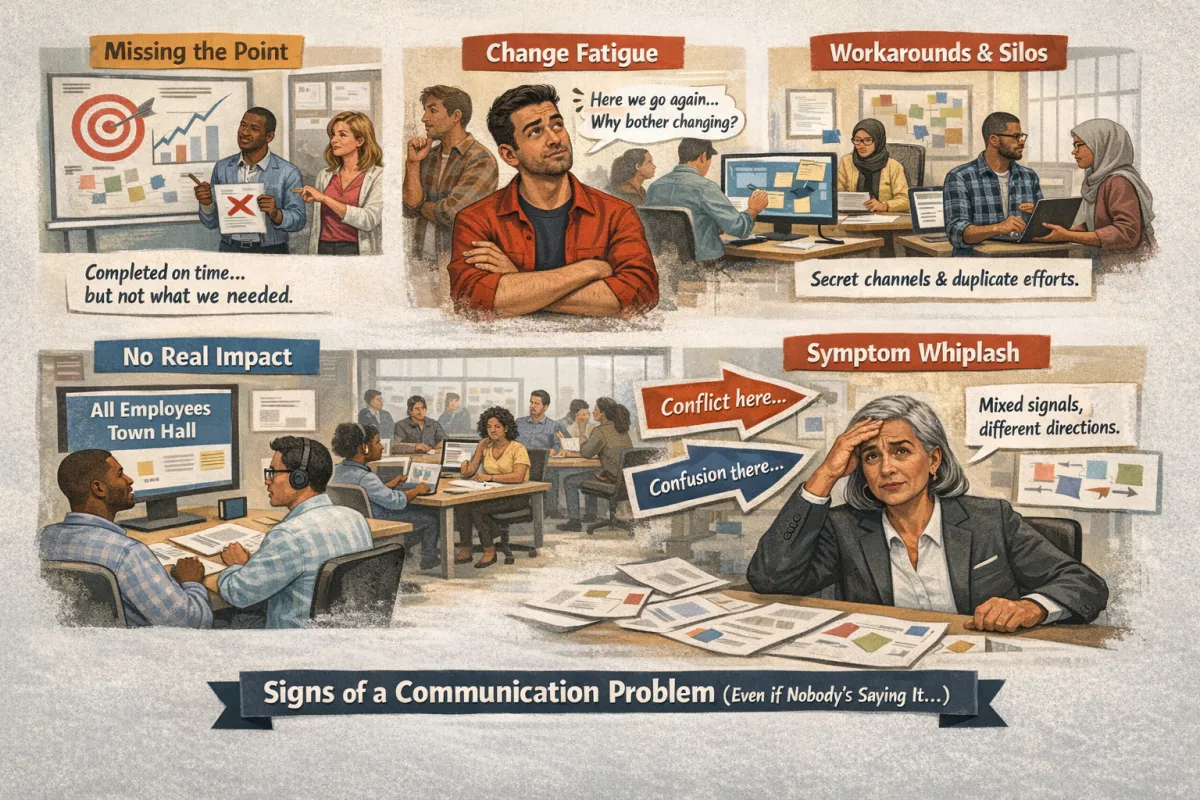
Five LESS Obvious Signs of a Comms Issue
Most companies look for obvious warning signs like rumors or open conflict, but communication issues usually show up in quieter ways first. Here are five non‑obvious indicators, across employee behaviors, data, and leadership symptoms, that your company has a communication problem, even if no one is calling it that yet.
Employees follow the plan but miss the point
When employees are executing tasks but still producing work that feels off‑strategy, you’re likely looking at a communication gap, not a performance problem.
Behaviors look like this:
Teams hit deadlines but deliver outputs that don’t match priorities or customer needs.
Teams are asking clarifying questions - deep into the project - that should have been resolved at the kickoff.
People rely on old decks, SOPs, or email threads instead of asking for updated direction, because they don't know who to ask for good information.
Data‑driven indicators show:
Projects technically done but there is still a lot of rework or scope-creep/scope-change late in the process.
Quality issues and defects trace back to misunderstood requirements, not technical skill.
Why leaders miss the signs:
Leaders often label this as a talent or accountability issue, when the deeper problem is that nobody knows where they are going or why. It's a comms problem. The intent isn’t being communicated in a way people can remember, repeat, and apply to real decisions.
Change fatigue shows up as attitude problem
Resistance to change is rarely about the change itself. It's usually about how (and how often) the change has been communicated.
Behaviors:
Increased eye‑rolling, sarcasm, or here we go again comments about new initiatives.
Front‑line employees quietly keep doing things the old way, even after new processes are rolled out.
People stop offering ideas because past suggestions went nowhere and team has no confidence that leaders will act on feedback.
Data‑driven indicators:
Higher error rates or safety incidents after process changes, suggesting people never fully understood the new expectations.
Call offs increase, and voluntary turnover shows up on teams most affected by change.
Why leaders miss it - they interpret this as low engagement or poor attitudes when the root issue is one‑way, top‑down communication. Leaders assume it's not them [the leaders themselves] - when they haven't done a good job explaining the why. Those at the top don't properly understand and respond to questions, and disregard feedback from people who are willing to speak up.
Work silos and work-around process become the norm
When existing communication channels don’t work, people build their own. Those fixes keep the lights on, but they’re also a quiet red flag.
Employee behaviors:
Teams create unofficial Slack channels, email lists, or spreadsheets to share information they can’t reliably access through official tools.
Departments duplicate work because they didn’t know another group was already tackling the same problem.
People rely on a few go‑to colleagues as human routers for information, instead of trusting the formal communication process. These go-to employees are often labeled as troublemakers when/if they address problems that leaders are ignoring. THIS is what I learned at my last corporate job. This is when I realized I wasn't cut out for corporate.
Data‑driven indicators
Multiple versions of the truth (different dashboards, reports, or metrics) in circulation.
Conflicting priorities between teams, visible in project backlogs, roadmaps, or conflicting KPIs.
Why leaders miss it - silos are often chalked up to organizational structure or personality clashes, but they’re more accurately a sign that teams don’t have a shared, consistent channel to get accurate information across the business.
Your communication metrics look fine - but nobody changes behavior
You may be sending messages and getting clicks, but that doesn’t mean your communication is working.
Employees:
Repeat key messages but can’t describe what they’re supposed to do differently because of them.
Town halls and newsletters are out there, but nobody changes when there is new info shared.
Managers privately ask, “What should I be telling my team to do with this?” after big announcements.
Indicators:
Healthy (enough) email open rates and intranet page views, but no measurable shift in core metrics tied to the communication (e.g., process adoption, tool usage, safety behaviors). In other words, vanity metrics look good - but real messaging fails to break through.
Survey items like “I understand the company strategy” score high, while “I see how my work connects to that strategy” scores lag.
Leaders miss it because traditional metrics (opens, clicks, attendance) look good. They assume communication is fine and blame execution. In reality, messages may be informational but not actionable, localized, or constantly reinforced at the right level.
Leaders see symptom whiplash across the business
From the C‑suite, communication problems often appear as scattered operational issues rather than a single pattern.
What leaders see:
Rising conflict in some pockets of the organization, while others are eerily quiet and disengaged.
Inconsistent adoption of new tools or processes between locations, teams, or shifts.
Mixed messages from middle managers, who each translate corporate communications differently (or not at all).
Data indicators:
Performance swings between similar teams that can’t be fully explained by market or resource differences.
Feedback loops showing lots of unsolicited questions, rumors, or repeated requests for clarification on the same topics.
Leaders miss each symptom because they are handled in isolation. They offer performance coaching here, a new tool there. The common thread is that messaging is unclear, inconsistent, or incomplete and never gets addressed as a systemic issue.
How to start diagnosing the REAL communication problem(s)
You can turn these subtle indicators into a practical diagnostic by doing three things:
Map symptoms to moments: For any hot spot (turnover, errors, resistance), ask, what did people hear, when, and from whom right before this started?
Add behavior‑based metrics: Track not just who opened a message, but whether they took the expected action (adopted a process, completed training, changed a setting, scheduled conversations).
Listen in both directions: Pair top‑down messages with structured upward feedback, pulse surveys, manager listening sessions, and visible action on what you hear.
When you treat these less obvious signals as communication data, you stop fighting fires and start fixing the system that fuels them.