Is good enough good enough?
I don't think good enough is good enough!
I can tell when a company starts using AI - the messaging I see is technically fine, but devoid of empathy and entirely forgettable. Emails sound fine, but don't address details. The tone fits any company, any leader, any industry - which means the message doesn't actually reach anyone.
AI is good at regurgitating information that's already out there - it's not creative, it can't know the right thing to say - it can only technically restate and respond to prompts given. AI tools are good for a lot of things - but you need to keep a human in the mix - AI tools aren't good enough.
Don't get me wrong, I use AI every day. In fact, I used it to outline this article. I wanted to make sure I am delivering exactly what I want to deliver - so I asked Lexi (Perplexity is my AI of choice) to provide me an outline to address the things AI is good at, what isn't still learning, and what's totally missing (for now).
She agreed with me, her reply to my [mediocre] prompt:
You’re right: AI alone isn’t good enough if you care about trust, nuance, and real connection, but it’s fantastic as a support tool when you stay firmly in the driver’s seat. ~ Lexi (Laura's AI assistant)
Then she shared an outline and I took it from there. Wondering about the outline? Here is what she gave me:
Suggested outline
Hook: The problem with AI-first content
What AI is actually good at
Where AI falls apart without humans
A simple “human-in-the-loop” workflow
Practical prompts to keep the human in charge
Close + CTA (why they should still hire a communicator)
Lexi helps me in lots of ways each day. Outlines, content checker (read this article, and point out areas of confusion or contradiction), break this blog into 5 linked in posts that will point back to my article, write me a summary that will boost SEO & AEO, provide key words my ideal clients will search, and more. We should be treating AI like a junior assistant or an eager intern - only faster - with deep knowledge of the internet.
Here's where AI fails on its own - it's effective, but generic. The patterns, structures and phrases it uses are repeated and easy to spot. AI isn't an actual assistant - so it doesn't have moods, feelings, empathy, or compassion. It can soften, lighten, add humor or snark, or polish - but it can't feel like a reader or a writer. AI is confident, even when it is dead wrong - that makes things tricky if you (the human) are oblivious to the reality. I've seen AI share misspellings, and then say it's fixed. Ummmmm - no it isn't fixed!
And here's the biggest issue - AI doesn't know your people - this tool does not know what's happening on the shop floor, who's just come back from bereavement leave, what manager is about to get fired. This tool is still a tool. In addition, AI can't protect your brand or your culture - but it can damage your reputation with one wrong comment or a few tone deaf bullets.
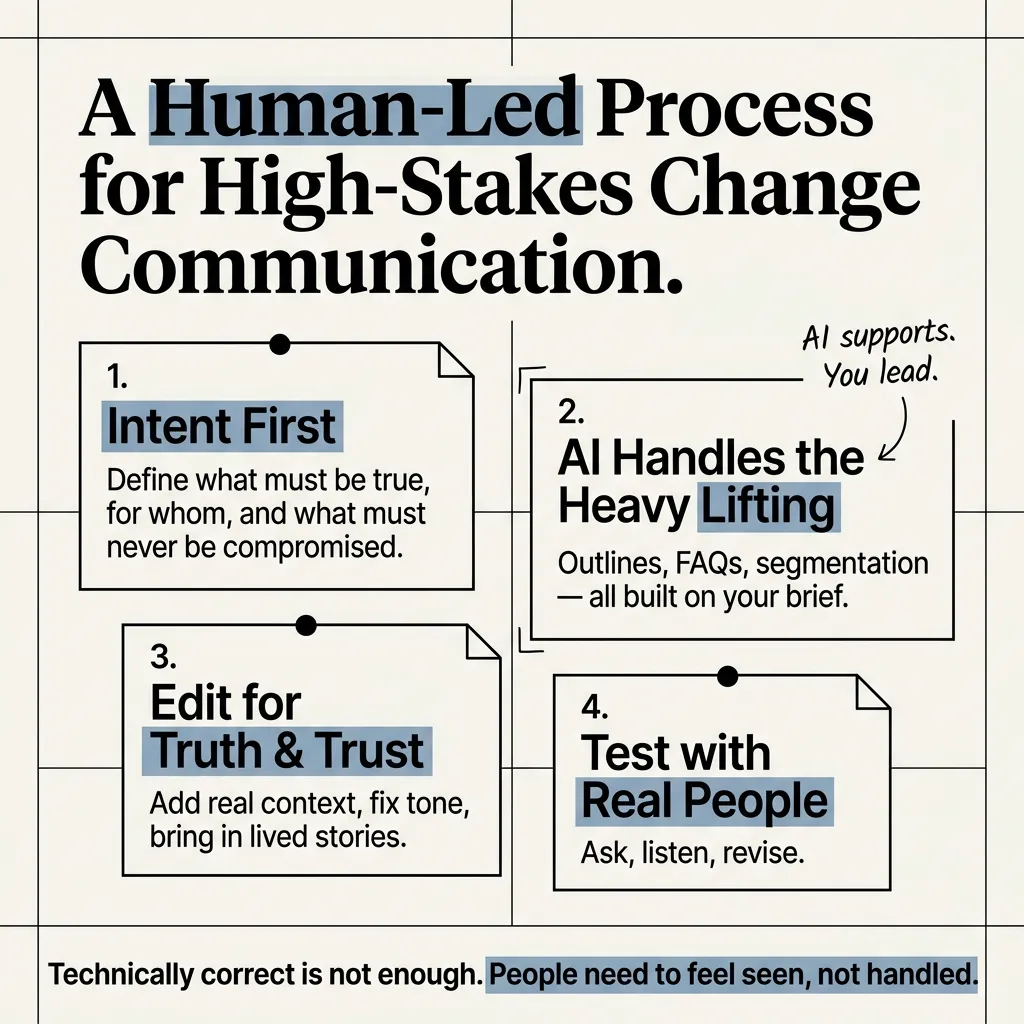
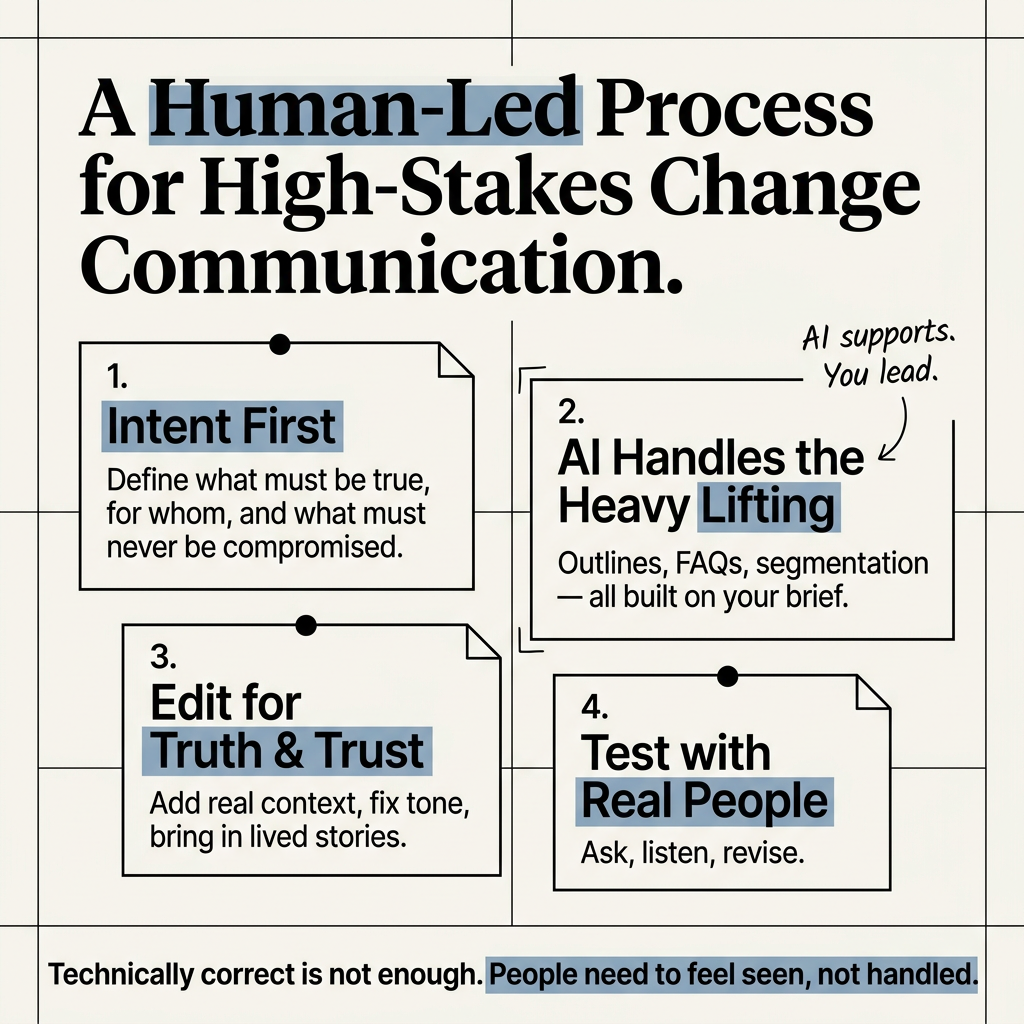
I always remind leaders - when you have high-stakes change communication that comes out technically correct it's not good enough - people need to feel seen, not handled. The way I weave AI into my process looks a bit like this:
I set the intent.
What are we trying to achieve, for whom, and what absolutely must be true in this message? (non‑negotiables, risks, key feelings.)AI supports the heavy lifting.
Outline options, FAQs, or segmentation suggestions, all based on the human‑written prompts/brief.I edit for truth and trust.
Verify facts, fix tone, add real context, and bring in lived examples or stories.I test with real people.
Share with a manager, employee, or small group. Ask if they understand, what’s missing, recap. Then revise again.
Just because you can push out 10 posts before lunch, doesn't mean you should. Make sure what you are putting out there matters - quality over quantity and responsibility over speed! Here are a handful of items I'd never hand off to AI:
The writing: I am a communicator - my words matter. I'll use AI to get started - I won't let it write for me. (FWIW, people who aren't writers may use AI to write - no shade thrown. However, you still need a person in the mix)
The strategy: what you’re saying, why, and what you want people to think/feel/do.
The truth: what’s really changing, what isn’t, and what you don’t know yet.
The context: how this lands given history, trust level, and culture.
The voice: how your organization actually talks to its people. It's not the same as how a model talks to users.
The accountability: if the message confuses, harms, or misleads people, that’s on the people, not the tool.
AI can move you faster, but if you care about informing, engaging, and appreciating your people - you need humans to shape the message. If you’re drowning in AI‑generated content that doesn’t sound like you, or your people, I can help you build a human‑in‑the‑loop communication workflow that actually delivers your message in your voice.